
Nome Is Growing. Our Zoning Should Make Room for the Businesses That Serve It.
Nome is about to add a lot of people. There are 120 units planned at the hospital, housing from local tribes and Native corporations, new trooper housing, and a 186-bed Kiewit camp. Every one of those residents will need plumbing, heating, electrical work, meals, cleaning, and bookkeeping. Those needs are opportunities for people who already live here.
Where the code falls short
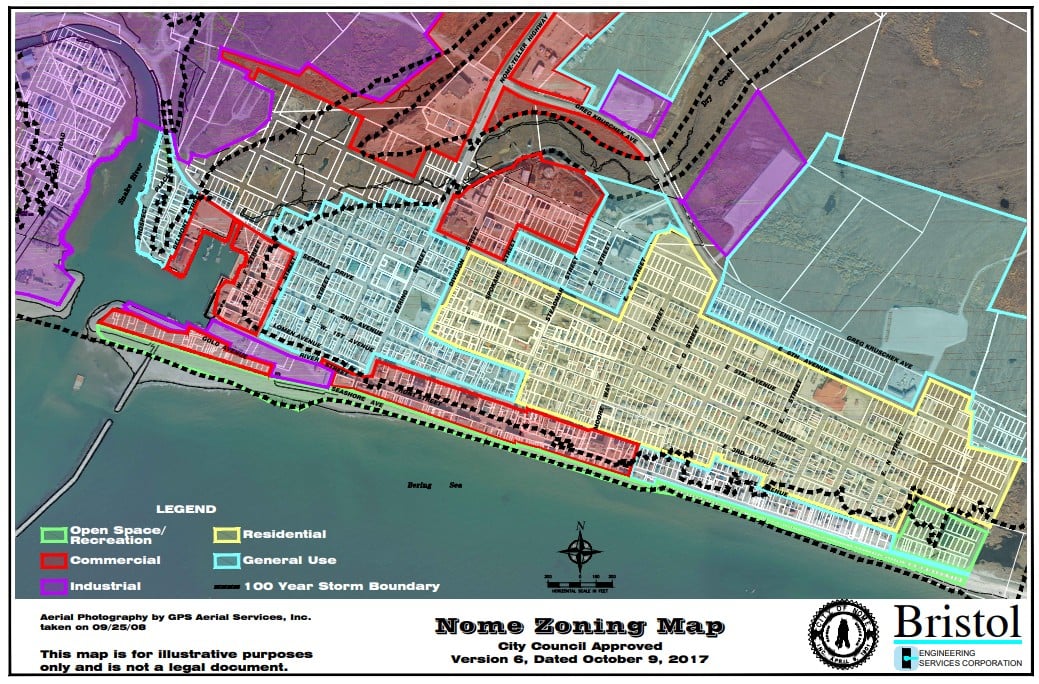
Nome's residential district is not closed to business. It permits home businesses, personal service businesses, and small-scale manufacturing and storage. But the home business definition is tight: the work has to happen entirely inside the dwelling, be done by the people who live there, and stay secondary to the residence. That works for a bookkeeper at the kitchen table.
It stops working when a business grows. Offices, vehicle and equipment repair, and warehousing are not allowed in residential districts at all, and there is no conditional path for them. Under 18.30.030, any use not listed is not permitted.
I recently worked with a client who runs a plumbing business from home. They planned to buy a parcel to scale up and were told zoning wouldn't allow it in a residential area. A local tradesperson with customers and money to invest was stopped by a rule, not by the market. Under § 18.50.020, certain non-residential and business-related uses are allowed by default in residential districts as permitted uses: [1 Ecode 360]
What I'm asking for, and what I'm not
I'm not proposing a machine shop or a bar next to anyone's house. I'm proposing a short, defined list of low-impact service uses, such as contractor offices, light repair, and modest equipment storage, that could be allowed in residential areas by conditional use permit.
Nome already has the tool to do this safely. Conditional use permits go through a public hearing, with notice to owners within 300 feet. The Planning Commission can attach conditions on hours, vehicle access, nuisances and more, and must consider traffic, noise, dust and activity levels. Where conditions can't solve the problem, the code says to deny the permit. Neighbors are protected by the process.
What other communities are doing
Anchorage's Assembly will take testimony on October 6 on a proposal called MMHOP, according to Alaska Public Media. It would drop the practical minimum lot size, and allow cottage courts and small multiplexes where only single-family homes or duplexes are allowed now. The principle is giving property owners a fuller menu of options, and Nome can apply it to small business.
The proposal
- Add a conditional path in residential districts for defined low-impact service uses that are currently not allowed, through an amendment to the use matrix. Council has amended that matrix as recently as July 2025.
- Use the existing conditional use process to set hours, vehicle, storage and noise limits case by case. Council has already adjusted zoning for the Kiewit camp on 6th Avenue, and the same flexibility should benefit local businesses also.
- Lower the 5,000-square-foot minimum lot size so smaller lots can be built on.
- Direct staff and the Planning Commission to use the unlisted-use process in 18.30.040 to classify common trades, so applicants know where they stand.
Why it matters
Across the country, communities are loosening restrictive zoning to respond to housing and economic pressure. If Nome doesn't, the work generated by all this new housing will go to contractors from outside the region while local tradespeople stay stuck in their garages.
I'm asking Council to review the use matrix and lot-size minimum and bring options back for public comment.
Check out this article next