

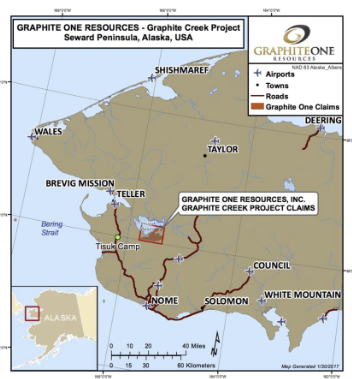
If you've been counting on a big federal decision on Graphite Creek at the end of September 2026, it isn't coming. The federal timeline just moved back a year.
What changed
The Army Corps of Engineers, the lead federal agency, told Graphite One it needs to complete a full Environmental Impact Statement instead of an Environmental Assessment. The company had forecast all permits complete by this September. The federal process is now expected to finish by September 2027. The Section 106 review under the National Historic Preservation Act is also now targeted for March 2027.
A quick refresher
You know the project: the largest known flake graphite deposit in the U.S., in a country that produced no natural graphite in 2024 and relies entirely on imports. A 2022 prefeasibility study projected about 53,600 dry metric tons of concentrate per year. That's a study projection, not a producing mine.
The company says nothing changes
Graphite One says it doesn't expect any delay to its proposed 2029 startup. Its reasoning is that it has done its permitting work at EIS level from the start.
I'd treat 2029 as a company target, not a schedule. Federal permitting is only one hurdle. State approvals and construction financing still have to come through, and a press release can't promise either.
Not everyone sees this as bad news
The local reaction is more mixed than "delay = bad." Bering Straits Native Corporation's president called the EIS a more comprehensive approach that gives subsistence users more chances to raise concerns. BSNC is a Graphite One investor, and the company's release says its leadership also signaled support for a full EIS. A watershed council leader called the decision a "win" for nearby tribes.
There's also some back-story worth noting. A company executive said last November that the Corps had determined the project wouldn't affect enough wetlands to need an EIS. The Corps reversing course tells me the wetlands and cultural questions are getting a harder look than many expected.
What this means for Alaska real estate
Here's my takeaway. Nobody should be pricing a property today off a mine that hasn't cleared federal review, hasn't secured all its state permits, and hasn't shown committed construction financing. Housing, land, or commercial demand tied to the mine is a "someday, maybe" story, and the "someday" just moved back a year.
That doesn't mean the project is dead. It means the numbers should stand on their own. If a deal only works when mine workers show up in 2029, it's a bet, not an investment. If it works without the mine and the mine is upside, that's a very different position to be in.
The longer review also gives communities more time to examine road, wetlands, and subsistence impacts. That could shape what the project looks like when, or if, it gets built.
What I'm watching
- The EIS schedule. Do the milestones hold, or does the date slip again?
- Section 106 consultation, targeted for March 2027.
- State of Alaska permits. The state handles much of the permitting, reclamation, and water rights for the mine itself.
- Financing. Committed construction money is the clearest sign a project is real.
Big projects in Alaska move slowly. The smart move is to stay patient and let the paperwork prove itself.
Check out this article next